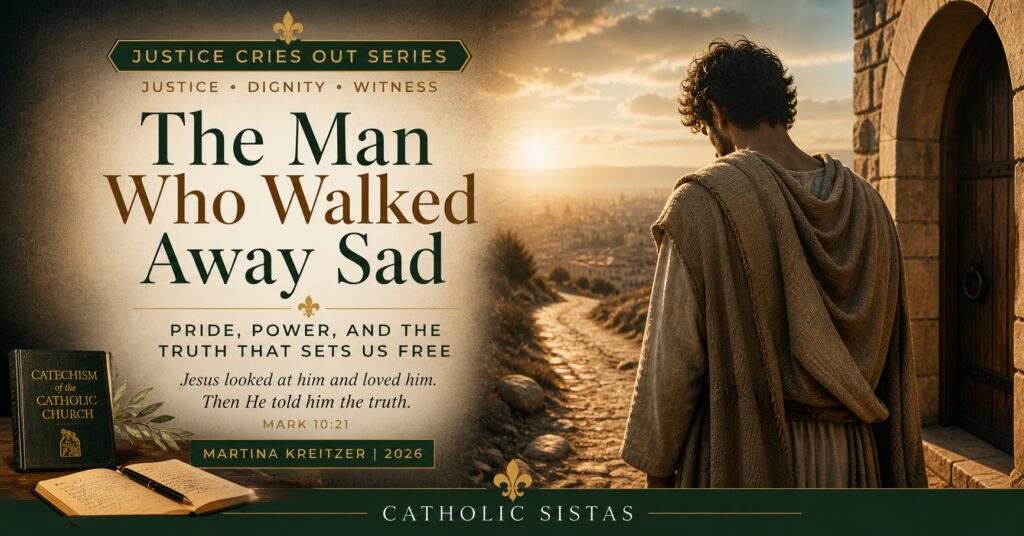

Justice · Dignity · Witness
The rich young man Catholic encounter in Matthew 19 is one of the most misread passages in Scripture – not because the theology is hard, but because the mirror it holds up is.
He came running.
That detail is easy to miss. In Mark’s account, the rich young man Catholic tradition calls “the one who walked away sad” does not stroll up to Jesus with a measured theological question. He runs. He falls to his knees. There is something urgent in him, something genuine. He is not testing Jesus the way the Pharisees test Him. He is not staging a trap.
He actually wants to know.
“Teacher, what good must I do to gain eternal life?” – Matthew 19:16
Jesus meets the question with love – and with the one answer the man cannot accept. He has kept every commandment since his youth. He is observant, respectable, and by every visible measure, righteous. Jesus looks at him and loves him (Mark 10:21). Then He tells him the truth.
The rich young man walks away sad. He has great possessions – and he chooses them.
Most readings of this passage treat it as a personal story about individual attachment to wealth. That reading is not wrong. However, it is incomplete. Because the man’s real problem is not his bank account. His real problem is what his wealth has made him believe about himself – and that belief has a name. It is pride. Furthermore, pride is precisely the thing that cannot fit through the needle’s eye, regardless of how much money accompanies it.
The Rich Young Man Catholic Teaching Misses: Pride, Not Wealth
What Money Cannot Buy but Pride Borrows
Fr. Cajetan Mary da Bergamo, writing in the eighteenth century in his spiritual classic Humility of Heart, offers an image that lands hard here. He describes a master loading his animals with burdens – one carries books, one carries gold, one carries weapons. The absurdity, da Bergamo says, is the animals boasting of what they carry as if it were their own. None of it belongs to them. Their knowledge, their gold, their strength – all of it was placed on their backs by someone else. They are simply carriers.
The rich young man has been boasting of his burden for a long time. His wealth, his observance, his reputation – none of it is his in any ultimate sense. He received it. Nevertheless, pride convinced him it was proof of his standing, his goodness, his closeness to God. As a result, when Jesus asks him to put it down, he cannot. Because without it, he does not know who he is.
Da Bergamo argues that pride is the foundational sin – the one beneath all others. It is not merely arrogance or boasting. Rather, it is a deep structural disorder: the refusal to see yourself accurately, in the light of what you actually are before God. Humility is not the opposite of confidence. It is the opposite of that refusal. It is the willingness to stand in the truth about yourself, stripped of everything that insulates you from that truth.
The rich young man’s wealth is his insulation. Take it away and he has to stand in the truth. He is not willing to do that. Therefore, he walks away sad.
Pride as the Root, Wealth as the Branch
This is the distinction the passage is making that most homilies miss. Jesus is not condemning wealth as an intrinsic evil. He is identifying the way wealth, in the hands of pride, becomes the mechanism through which a soul protects itself from conversion.
St. Bernard of Clairvaux, himself a son of Burgundian nobility who admitted that humility was the most elusive virtue he ever pursued, mapped this dynamic in his work The Steps of Humility and Pride. The first step downward into pride, he writes, is curiosity – specifically, the refusal to examine yourself honestly. The proud person looks outward and upward, comparing themselves favorably to others, measuring their standing by external markers. Consequently, they never look honestly inward. What they would find there would be too costly.
The rich young man is on this staircase. He has compared himself to every standard available to him and come out favorably every time. He has kept all the commandments. Nobody in his social world has told him otherwise. Moreover, nobody below him in the social hierarchy is in a position to tell him otherwise. His wealth has purchased him protection from that kind of truth.
St. Faustina records in her Diary that Christ said to her:
“The torrents of grace inundate humble souls. The proud remain always in poverty and misery, because my grace turns away from them to humble souls.” – Diary of St. Faustina, 1602
This is the Kingdom’s economy stated plainly. The proud man, however wealthy by worldly measure, is spiritually bankrupt. The humble soul, however poor by worldly measure, is rich in the only currency that matters.
The Currency the Kingdom Actually Runs On
The Beatitudes establish this economy from the Sermon on the Mount. “Blessed are the poor in spirit, for theirs is the Kingdom of Heaven.” (Matthew 5:3) The Catechism unpacks this with precision: the Word speaks of voluntary humility as “poverty in spirit,” and the Apostle gives the supreme example of God’s own poverty when he says, “For your sakes He became poor.” (CCC 2546)
This is the theological core of what sits in your chest when this passage lands. The rich young man Catholic encounter in Matthew 19 is not ultimately about money. Rather, the Kingdom does not run on net worth, legal resources, institutional influence, or the ability to outlast someone in a proceeding. It runs on humility. Furthermore, humility is the one thing that wealth cannot purchase, power cannot manufacture, and pride cannot counterfeit.
You cannot buy your way to humility. In fact, every dollar spent protecting your pride is a dollar spent moving you further from the needle’s eye. Every deployment of institutional power to avoid accountability is another degree of pride on St. Bernard’s staircase. Every curated narrative that protects your self-image from accurate examination is, in da Bergamo’s terms, the animal boasting about what its master placed on its back.
The Catechism is direct about what this means spiritually: “Let the proud seek and love earthly kingdoms, but blessed are the poor in spirit for theirs is the Kingdom of Heaven.” (CCC 2547) The proud man and the humble man are not competing for the same thing. They are operating in different economies entirely.
What Wealth Buys That Cannot Be Named
The Insulation Problem
One of the things wealth purchases that is rarely named in polite company is insulation from accountability. When you have resources, you can protect yourself from consequences that would otherwise reach you. Attorneys can be hired when others cannot afford them. A legal proceeding can be outlasted because you have the capacity to fund it and they do not. Furthermore, a public narrative can be constructed and sustained because you have access to platforms and professionals that shape perception.
None of this is inherently illegal. Much of it is not even unusual. Nevertheless, the Church has something specific to say about it. The Compendium of the Social Doctrine of the Church states that authority is legitimate only when it serves the common good, and that the use of power to harm the vulnerable is a violation of the dignity of the human person (Compendium, 396-398). Pope Leo XIII, writing in Rerum Novarum, went further: “To defraud any one of wages that are his due is a great crime which cries to the avenging anger of Heaven.” What we now call the abuse of power – using resources, legal systems, or institutional authority to harm those with less – sits in the same theological category.
The Narrative Problem
Wealth also purchases the ability to control a story. The rich young man never had to reconcile his self-image with inconvenient truth because his resources protected him from anyone who might have delivered it. He kept all the commandments. Nobody with less power than him was in a position to tell him otherwise.
The Catechism’s treatment of the eighth commandment addresses this directly. Detraction – revealing true but damaging information without legitimate reason – is a sin. Calumny – asserting things known to be false – is worse. However, the use of selectively true information to construct a false impression, particularly when done to harm someone who cannot defend themselves equally, falls within the Church’s concern for justice in speech (CCC 2477-2480). Pride and the resources it commands do not sanctify that use.
St. Ambrose of Milan, writing in the fourth century about a wealthy man who used legal and social power to seize a poor man’s vineyard, was unambiguous: the law did not make it right. The existence of a legal mechanism did not constitute moral permission. In fact, it compounded the offense – because it added the corruption of justice to the original harm.
Zacchaeus and What Conversion Actually Looks Like
Luke places the story of Zacchaeus immediately after the rich young man passage, and that placement is deliberate. Zacchaeus is also wealthy. Furthermore, as a tax collector in first-century Palestine, his wealth was at least partially built on extraction – taking more than was owed from people who had no legal recourse against him.
The Rich Young Man Catholic Contrast: Zacchaeus
However, Zacchaeus does something the rich young man Catholic tradition holds up as the counter-model. Rather than protecting himself, he humbles himself publicly and completely. He climbs a tree and is laughed at. Out loud, in front of everyone, he announces his failures – without waiting for a private conversation with Jesus to sort it out first. He stands in the truth about himself in public, without the protection his wealth could have afforded him.
And then he does not merely feel remorse. He makes restitution – and not minimal restitution. He commits to giving back fourfold to anyone he has defrauded. (Luke 19:8) That is the Church’s definition of genuine conversion from the abuse of power: not a feeling, but a reversal. What was taken is returned. What was damaged is restored.
Jesus says: “Today salvation has come to this house.” (Luke 19:9) Not because Zacchaeus felt bad. Because he stood in humility before the truth and let it cost him something real.
The contrast is exact and intentional. Both men are wealthy. Both men encounter Jesus. One walks away sad. One climbs down from a tree with salvation in his house. The difference is not their net worth. It is whether pride or humility is sitting in the driver’s seat.
Nathan, David, and the Rich Young Man Catholic Mirror
There is an older story beneath this one. In 2 Samuel 12, the prophet Nathan approaches King David after David has used the full weight of royal power to take Bathsheba and arrange the death of her husband Uriah. David is king. He has, by worldly measure, the authority to do what he has done. Nobody below him is in a position to stop him or correct him.
Nathan does not confront him directly. Instead, he tells him a parable about a rich man who, despite having many sheep of his own, takes the single beloved lamb of a poor man. David is furious. He declares that the man deserves to die and must restore fourfold.
Nathan says: “You are the man.” (2 Samuel 12:7)
David cannot see his own face until he sees it in the mirror of a story. His wealth and power have insulated him from the kind of self-knowledge the poor are forced into daily. He had to be told. Furthermore, the telling was dangerous – Nathan risked everything to say it. However, this is precisely what the prophetic tradition has always done: held the mirror up to power and refused to let wealth purchase an exemption from truth.
The pattern repeats across Scripture. Those with power rarely seek out the truth about what their power is doing. Those without power rarely have the standing to deliver it. God, however, has a way of ensuring the message arrives anyway. And when it does, the only question is whether the listener will be David – who fell on his face and repented – or the rich young man, who walked away sad.
A Word for Those on the Other Side of the Needle
If you are reading this because you are on the receiving end of a power imbalance – because someone with more resources, more attorneys, or more institutional standing has turned that advantage against you – the Gospel has something specific to say to you too.
You are seen. What is being done is named. The God who hears the cry of the worker whose wages are stolen, who hears the cry of the falsely accused, who heard Uriah in the story that David thought he was controlling – that God has not missed this.
Romans 12:19 is not a comfort verse. Rather, it is a structural statement: “Beloved, do not look for revenge but leave room for the wrath of God; for it is written, vengeance is mine, I will repay, says the Lord.” It does not say the wrong will go unaddressed. It says the address is not yours to manage.
That is both harder and more liberating than it sounds. Consequently, you do not have to carry the weight of making justice happen. You also do not have to pretend that the needle is not measuring them as they walk past it. Your only task is to trust the one who holds it.
The rich young man Catholic readers encounter in Matthew 19 walked away sad. He was not wrong that something was missing. However, he was wrong about what it would cost him to find it. The cost was not his bank account. The cost was his pride – the thing his bank account had been protecting all along.
Reflection Questions
Use these for personal prayer, journaling, or small group discussion. A printable version is available for download below.
1. Where in your own life have your resources – financial, social, relational, or institutional – insulated you from accurate self-knowledge? What would it look like to stand in the truth about yourself without that insulation?
2. Da Bergamo describes pride as the animal boasting about what its master placed on its back. What are you carrying that you have mistaken for your own? What would it feel like to set it down?
3. St. Bernard says the first step of pride is the refusal to examine yourself honestly. Is there something about your own choices – the use of power, resources, or influence – that you have been avoiding looking at directly? What would Nathan say to you?
4. Zacchaeus did not merely feel remorse – he made restitution, and fourfold. Is there someone you have harmed through an imbalance of power or resources? What would genuine restitution look like, not as a feeling but as an action?
5. St. Faustina records that Christ said the proud remain always in poverty and misery because His grace turns away from them to humble souls. In your current season, where are you experiencing spiritual poverty – and is pride anywhere in the diagnosis?
6. If you are on the receiving end of a power imbalance right now – being outspent, outmaneuvered, or targeted by someone with more resources – what does it mean practically to leave room for the wrath of God rather than trying to manage the outcome yourself?
7. The rich young man came running. He was sincere. Have you ever been genuinely seeking God and still walked away from what He asked? What did you walk away carrying – and what did it cost you?
Citations and Sources
Scripture
- Matthew 19:16-30 – The rich young man; the camel and the needle – USCCB NABRE
- Mark 10:17-31 – He came running; Jesus looked at him and loved him
- Luke 19:1-10 – Zacchaeus; fourfold restitution; salvation comes to this house
- 2 Samuel 11-12 – David, Uriah, Bathsheba, and Nathan: You are the man
- Matthew 5:3 – Blessed are the poor in spirit, for theirs is the Kingdom of Heaven
- Romans 12:19 – Vengeance is mine, says the Lord
Catechism of the Catholic Church
- CCC 2546-2547 – On poverty in spirit, the Beatitudes, and the Kingdom’s economy – Vatican
- CCC 2477-2480 – On detraction, calumny, and justice in speech – Vatican
- CCC 1807 – On justice as rendering each his due – Vatican
Church Documents
- Pope Leo XIII, Rerum Novarum (1891) – On just wages and the rights of workers – Vatican
- Compendium of the Social Doctrine of the Church, 396-398 – On legitimate authority and the common good – Vatican
- USCCB, The Dignity of Work and the Rights of Workers – USCCB
Recommended Reading
- Fr. Cajetan Mary da Bergamo, Humility of Heart (TAN Books) – the definitive Catholic study on humility as the foundational virtue; da Bergamo’s animal analogy captures the absurdity of pride in wealth and power more vividly than any other treatment – TAN Books
- St. Bernard of Clairvaux, The Steps of Humility and Pride (Cistercian Fathers Series) – maps the twelve degrees of pride beginning with curiosity and the refusal to examine yourself honestly – Amazon
- St. Faustina Kowalska, Divine Mercy in My Soul (Diary) – contains the Lord’s statement that the proud remain in poverty and misery because His grace turns away from them to humble souls (entry 1602) – Divine Mercy
- Catholic Answers – What Did Jesus Mean by the Eye of a Needle? – Catholic Answers
This post is part of the Justice Cries Out series on Catholic Sistas – exploring what the Church actually teaches about power, dignity, wages, and the God who hears what the world tries to silence.
Subscribe to the Catholic Sistas email list so you do not miss the next post in the series.