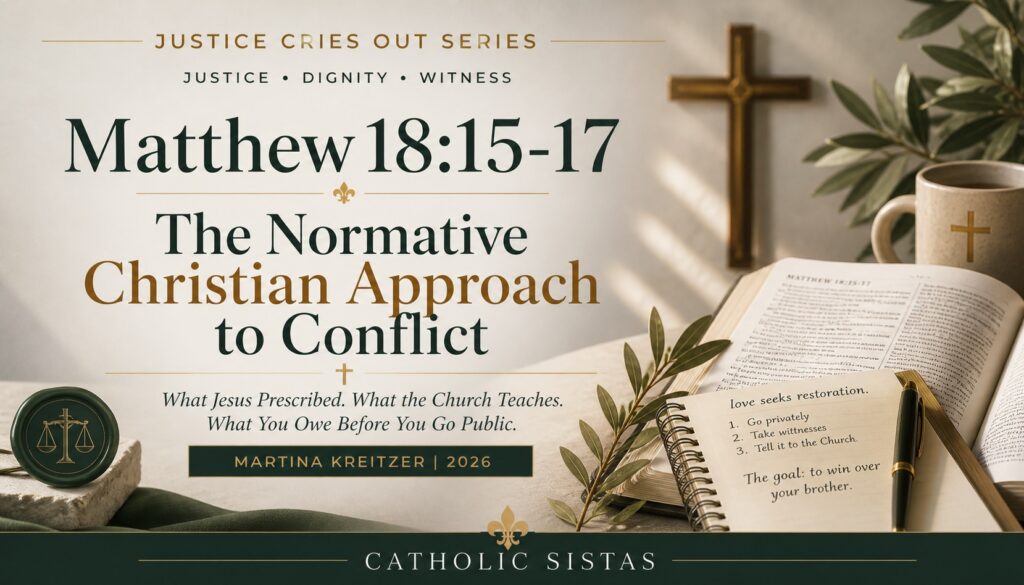

Justice · Dignity · Witness
Jesus did not leave us without instruction on how to handle conflict. In Matthew 18:15-17, He gave His followers a precise, sequential prescription – three steps, in order, with a specific purpose behind each one. Matthew 18 conflict resolution is not a suggestion for the spiritually advanced. It is the normative Christian standard. Every step is mandatory. The sequence is not optional. And the way someone handles conflict – whether they follow this prescription or ignore it entirely – tells you everything about what they actually want from the situation.
This post is not about conflict in the abstract. It is about what Jesus commanded, what the Church teaches, and what it means when someone who claims the faith skips every step He prescribed and goes straight to maximum damage. The prescription is simple. The implications are serious. Furthermore, the God who gave the prescription is paying attention to whether it was followed.
The Matthew 18 Conflict Resolution Prescription in Full
Matthew 18:15-17 reads:
“If your brother sins against you, go and tell him his fault between you and him alone. If he listens to you, you have won over your brother. But if he does not listen, take one or two others along with you, so that every fact may be established on the testimony of two or three witnesses. If he refuses to listen to them, tell it to the church. And if he refuses to listen even to the church, then treat him as you would a Gentile or a tax collector.” – Matthew 18:15-17 (NABRE)
Three steps. In order. Each one contingent on the failure of the one before it. Jesus is explicit: you go privately first. If that fails, you bring one or two witnesses. Only if that fails does the matter become public. The sequence is not incidental. It is the point.
The Natural Right to Reputation
Furthermore, the entire framework rests on a single stated goal: to win over your brother. Punishment is not the aim. Destruction has no place in it. Public exposure is not the goal either. Winning him over is. Every step in the prescription serves that goal – and the moment someone abandons that goal, the prescription no longer applies to what they are doing.
Step One – The Private Conversation You Owe
What the Step Requires
The first step is non-negotiable. Go to him alone. His employer is not your first stop. A lawyer is not your first stop. A public platform, a mutual friend, an ally primed to take your side – none of these come before the private conversation. Him. Alone. First.
This step protects the person who has wronged you in ways that matter morally. It gives them the opportunity to hear the fault named, to respond, to correct, and to restore – without public exposure, without institutional consequences, without the kind of reputational damage that is almost impossible to repair once it has been done. St. John Chrysostom, in his homily on this passage, wrote that Jesus sends the injured party to the offender precisely because the goal is cure, not punishment. The private step is the first attempt at the cure.
It also protects the relationship. Public action before private conversation almost always guarantees that no restoration will follow. Consequently, the person who skips step one and goes straight to public damage has made a choice – whether they admit it or not – that the relationship is not worth the attempt at private repair. They have revealed, before any other action, what their priority actually is.
What the Step Reveals When Skipped
Here is where the Matthew 18 conflict resolution prescription becomes a mirror. When someone has a genuine grievance and follows the standard, the sequence reveals their character: they went privately first, they sought restoration, they gave the other person every reasonable opportunity before escalating. The sequence is a record of good faith.
However, when someone skips step one entirely – when they go straight to public accusation, institutional action, legal proceedings designed to inflict maximum damage, or campaigns to destroy someone’s reputation and livelihood – the sequence reveals something else entirely. Restoration was never the goal. Silencing was. Winning in a way that leaves the other person unable to recover – that was the actual aim from the beginning.
Therefore, you do not need to speculate about the intent of someone who skips step one. They have told you their intent by the action they chose. Jesus gave everyone the same prescription. The person who ignores it made a deliberate choice to ignore it. That choice is not a mistake. It is a decision.
Step Two – Witnesses, Not an Army
What the Step Requires
If the private conversation fails – if the person refuses to listen, refuses to acknowledge the fault, refuses to repair the harm – then and only then does Jesus permit escalation. Even then, the escalation is carefully defined: one or two others, brought in as witnesses, so that every fact may be established.
The witnesses Jesus prescribes are not allies. They are not people recruited to strengthen your case. One commentator on this passage, drawing on the original Greek context, notes that the witnesses are brought to listen objectively to both sides – people of impeccable integrity whom the accused will recognize as fair and impartial. The step is not designed to increase pressure on the offender. It is designed to ensure that both parties are heard accurately and that the facts are established by more than one person’s account.
This is fundamentally different from assembling a legal team, a public relations apparatus, or a campaign of institutional pressure. Jesus prescribed two people with integrity. The prescription is modest, measured, and still oriented entirely toward the possibility of resolution.
The Standard of the Witnesses
The reference to “two or three witnesses” in verse 16 draws on Deuteronomy 19:15: “A single witness shall not prevail against someone in regard to any crime or any offense. A matter may be established only on the testimony of two or three witnesses. Jesus grounds the second step in the existing legal and moral tradition of His people – a tradition that required multiple, credible, independent witnesses before anyone could establish a serious charge.
In other words, Jesus set the same standard for step two that a fair legal proceeding has always been supposed to apply. Charges require credible testimony. The accused holds the right to face and examine accusers. Furthermore, the purpose of establishing the facts is still restoration – even at this stage, the goal remains winning over the brother, not destroying him.
Step Three – When Public Becomes Necessary
What the Step Requires
Only after both private conversation and witnessed conversation have failed does Jesus permit bringing the matter before the community. Even then, the community He prescribes is the church – the body of believers who share a common commitment to restoration, to truth, and to one another’s wellbeing. The purpose is not public exposure for its own sake. It is a final attempt to bring the offender to accountability before the community that has the moral authority to call him home.
Stanley Hauerwas, commenting on this passage, made the point precisely: excommunication – the ultimate consequence of step three – is not throwing someone out. It is an act of love that names what has already happened: the person has made themselves a stumbling block and is already, in a meaningful sense, outside the community. The church’s public action is a call to come home, not a sentence of final condemnation.
Furthermore, Jesus immediately follows this passage with Peter’s question about forgiveness – how many times must I forgive? Seven times? And Jesus answers seventy times seven. The prescription for conflict resolution exists within a framework of radical, repeated, inexhaustible forgiveness. The steps are not a mechanism for punishment. They are a process for truth – and the truth they serve is always aimed at restoration.
What Makes Step Three Legitimate
Step three of the Matthew 18 conflict resolution process is legitimate only when steps one and two have genuinely been attempted and genuinely failed. This is not a technicality. The legitimacy of any public action depends entirely on what happened before it. A person who went privately, brought witnesses, and only then made the matter public has followed the prescription. Their public action carries the moral authority of a process that gave the offender every reasonable opportunity.
A person who skipped directly to public destruction has no such authority. Their action is not step three. It is a different kind of action entirely – one that Jesus did not prescribe and that the Church names with precision in CCC 2477: the disclosure of another’s faults and failings without objectively valid reason. Skipping the sequence disqualifies the public action. It strips it of moral authority entirely.
What the Catechism Adds to Matthew 18 Conflict Resolution
The Catholic Church’s teaching on the eighth commandment runs in direct parallel to the Matthew 18 standard and reinforces it from a different angle. CCC 2477 states: “Respect for the reputation of persons forbids every attitude and word likely to cause them unjust injury. He becomes guilty of rash judgment who, even tacitly, assumes as true, without sufficient foundation, the moral fault of a neighbor; of detraction who, without objectively valid reason, discloses another’s faults and failings to persons who did not know them; of calumny who, by remarks contrary to the truth, harms the reputation of others and gives occasion for false judgments concerning them.”
Three categories of sin against the eighth commandment. Three parallel failures to the Matthew 18 sequence. Rash judgment happens when you assume the worst without sufficient foundation – when you skip the private conversation that would have let you hear the other side. Detraction happens when you disclose someone’s failings publicly without objectively valid reason – when you go public before you have exhausted private means. Calumny happens when you harm someone’s reputation with remarks contrary to the truth – the destination you often arrive at when you have skipped the process designed to establish what the truth actually is.
Furthermore, CCC 2479 states: “Detraction and calumny destroy the reputation and honor of one’s neighbor. Honor is the social witness given to human dignity, and everyone enjoys a natural right to the honor of his name and reputation and to respect. That right belongs to the accused. It exists before any finding is made. And it obligates the person with a grievance to follow a process that protects that right – which is precisely what the Matthew 18 sequence does.
The Intent the Sequence Reveals
We return to the point that is most important and most unambiguous: the way someone handles conflict reveals their intent. Jesus built this into the prescription deliberately. The sequence is not just a procedural checklist. It is a diagnostic tool. It tells you – and tells the community around you, and tells God – what you actually want from this conflict.
Restoration or Destruction
The person who wants restoration follows the Matthew 18 conflict resolution steps. Going privately first is their first move. The other person receives the dignity of a direct conversation. The relationship gets the chance of surviving. Moreover, this person humbly acknowledges they might not have the complete picture – and leaves room for correction if they have misunderstood something.
The person who wants destruction skips that step entirely. They deploy every available weapon – legal, reputational, financial, institutional – before anyone exchanges a single private word. Making it impossible for the other person to correct, restore, or respond on equal footing is the point. And all of this happens while they claim the moral authority of the aggrieved party.
However, the Matthew 18 standard strips that moral authority away from anyone who skips the sequence. You cannot claim the authority of the wronged party while simultaneously violating the explicit command Jesus gave to the wronged party about how to respond. The prescription is for everyone. Its violation is visible to everyone who knows it. Consequently, the person who goes straight to destruction has not just wronged the person they are targeting. They have answered the question of their own character in public, for anyone with eyes to see it.
What God Sees
Matthew 18:18-20 follows the conflict prescription immediately with a striking statement: whatever you bind on earth shall be bound in heaven, and whatever you loose on earth shall be loosed in heaven. Jesus connects the handling of conflict directly to the moral authority of heaven. The process matters. The sequence matters. The intent behind the sequence matters. Furthermore, God sees what happens in secret – the private step someone skipped, the conversation they never attempted, the opportunity to respond they never extended – even when everyone else remains blind to it.
“Chrysostom, commenting on these verses, noted that the blame falls not on the one who called for accountability but on the one who refused persuasion. In other words, the moral weight lands on the person who refused correction after a legitimate process – not on the person who followed the prescription and still met refusal.” However, both the prescription and the refusal must be real. Someone must genuinely attempt the sequence before invoking the final consequence.
God sees which steps were taken and which were skipped. The conversation that was never offered – He sees it. The private approach that was never made – He sees that too. The choice to go straight to carnage when the prescription called for going first in love – He sees that too. And the community that follows Christ should be able to see it too – not to judge souls, but to recognize behavior for what it is and name it accurately.
A Direct Word to Anyone in Conflict Right Now
If you have a genuine grievance with someone – a real wrong, something that demands to be addressed – the Matthew 18 conflict resolution prescription is clear. You go to them. Privately. First. Every time. Without exception.
Their employer is not your first call. A lawyer is not your first call. Building a public case before a private conversation has happened violates the prescription. Recruiting allies before offering the other person the dignity of hearing from you directly violates it further. If you are a Christian, Jesus left this step without an exit. The sequence is not a suggestion. It is a command.
Furthermore, if private conversation fails, you bring witnesses – people of integrity who will listen to both sides, not allies recruited to strengthen your position. And only if that fails do you bring the matter to the community. In that order. Every time.
If someone skipped every step with you – went straight to maximum damage without a single private conversation, without a single attempt at resolution, without giving you any opportunity to respond on equal footing – Chrysostom’s observation applies directly: the moral weight falls on the one who refused correction after a legitimate process. Except in your case, there was no legitimate process. There was only the decision to skip it. And that decision speaks for itself – to you, to the community, and to God.
What You Owe the Person Who Skipped the Prescription
Here is the question every person on the receiving end of a skipped sequence eventually asks: if someone ignored every step Jesus prescribed and came straight at you with maximum damage – what do you owe them in return? Hostility? Silence? The same disregard for the prescription they showed you?
The answer is none of those things. And the fact that it is none of those things is simultaneously the hardest and most clarifying truth in this entire conversation.
You Do Not Owe Them Hostility
Hostility is a response of the flesh, not the Spirit. It gives the aggressor something they can use against you – evidence of your bitterness, proof of your disproportionate response, a narrative in which you become the problem. Furthermore, hostility damages the person carrying it more than the person it targets. Bitterness is a poison you drink hoping it hurts someone else. The Matthew 18 conflict resolution standard exists precisely to prevent this – to keep the process ordered, purposeful, and aimed at truth rather than at destruction in either direction.
You Do Not Owe Them Passive Submission
Turning the other cheek does not mean surrendering your rights, your defense, or your dignity. The Greek word Jesus used in Matthew 5:39 – anthistemi – means do not take legal counter-action for a personal insult. It does not mean absorb institutional assault without response. It does not mean stand quietly while someone uses legal machinery, financial resources, or public platforms to destroy your livelihood and reputation. The Church is explicit on this. CCC 2263-2265 establishes that legitimate defense can be not merely a right but a grave duty – particularly when you are responsible for others whose protection depends in part on your willingness to stand. We go deeper on this in Mercy Without Justice Is the Mother of Dissolution.
What You Actually Owe Them
You owe them your prayers. Matthew 5:44 is still binding regardless of what they have done or failed to do. Love your enemies. Pray for those who persecute you. This is not optional, it does not require warmth, and it does not require you to pretend what happened was acceptable. It requires the act of the will that brings them before God and asks Him to reach them before they do more damage to themselves. We go deeper on this in When You Are Someone’s Enemy: A Catholic Guide to Praying for Those Who Hate You.
You owe them the truth spoken accurately and you do not owe them a false narrative about what happened. You are not even required to absorb their account in silence when it is wrong. Speaking the truth accurately – without embellishment, without venom, without calumny aimed back in their direction – is what justice requires. Furthermore, speaking that truth through the proper channels, in the proper sequence, is itself an act of respect for the prescription they ignored.
You owe them the same prescription they denied you. This is the most counterintuitive obligation of all. Even when someone skips the Matthew 18 conflict resolution sequence against you, that sequence still binds your response. Answering their violation by committing your own violation is not permitted. Going to them privately – if it is possible and safe – remains the first move. Pursuing legitimate defense through proper channels follows if needed. Telling the truth publicly comes only when the process has genuinely been exhausted. The prescription holds even when the other party ignored it – because it was never about them. It was always about who you choose to be.
Hold the Door Open
And finally – hold open the possibility of their repentance. Not naivety. Not pretending the wrong did not happen. Rather, hold the theological reality that conversion is always possible until it is not. Zacchaeus converted. Paul’s life turned completely around. David fell on his face and repented. The door remains open until they close it – and closing it for them is not your call. That restraint – that refusal to write off the soul of even the person who has come hardest against you – is perhaps the most demanding and most distinctly Christian thing this entire prescription asks of you.
Reflection Questions
Use these for personal prayer, journaling, or small group discussion.
1. Think of a current or recent conflict in your life. Which step of the Matthew 18 sequence have you reached – and have you genuinely completed each prior step before moving to the next?
2. The goal of the Matthew 18 prescription is to “win over your brother” – restoration, not punishment. Honestly examining your own heart: is restoration your goal in this conflict, or is something else driving your response?
3. Have you ever skipped step one? Have you gone public, or to institutional authority, before going privately to the person first? What drove that choice – and what does the Matthew 18 standard say about it?
4. The witnesses Jesus prescribes in step two are people of integrity who listen to both sides – not allies recruited to strengthen your position. Who in your life could serve as that kind of witness? Are you willing to submit to that kind of impartial accountability?
5. CCC 2477 says that detraction – disclosing someone’s faults publicly without objectively valid reason – is a sin. How does the Matthew 18 sequence define what an “objectively valid reason” looks like? Have you met that standard in the conflicts you have brought into public view?
6. If someone has skipped the Matthew 18 sequence against you – going straight to destruction without a single private conversation – what does the standard tell you about their intent? And what does it tell you about where the moral weight falls?
7. Jesus follows the conflict prescription immediately with the command to forgive seventy times seven. How do you hold both the requirement for just process and the command for radical forgiveness at the same time? What does it look like to pursue justice without abandoning forgiveness?
8. God sees the steps that we take and the steps we skipped. What do you want Him to see in the way you have handled conflict – and is that what He is actually seeing right now?
Citations and Sources
Scripture
- Matthew 18:15-17 – The three-step conflict prescription – USCCB NABRE
- Matthew 18:18-20 – Whatever you bind on earth shall be bound in heaven
- Matthew 18:21-22 – Forgive not seven times but seventy times seven
- Deuteronomy 19:15 – A matter may be established only on the testimony of two or three witnesses
- 1 Corinthians 5:3-5 – Paul on community accountability and restoration
Catechism of the Catholic Church
- CCC 2477 – On rash judgment, detraction, and calumny – Vatican
- CCC 2478 – On interpreting a neighbor’s thoughts and deeds in a favorable way – Vatican
- CCC 2479 – Detraction and calumny destroy the reputation and honor of one’s neighbor – Vatican
Church Fathers
- St. John Chrysostom, Homily 60 on Matthew – On the goal of cure rather than punishment in conflict resolution – New Advent
- Catena Aurea, St. Thomas Aquinas – Patristic commentary on Matthew 18 – New Advent
Further Reading
- Stanley Hauerwas – Commentary on Matthew 18 conflict resolution and the meaning of excommunication as an act of love
- USCCB – The Dignity of the Human Person and the Eighth Commandment – USCCB
- Theology of Work – Conflict Resolution in Matthew 18:15-35 – Theology of Work
This post is part of the Justice Cries Out series on Catholic Sistas – exploring what the Church actually teaches about power, dignity, witness, and the God who sees every step that was taken and every step that was not.
— M.