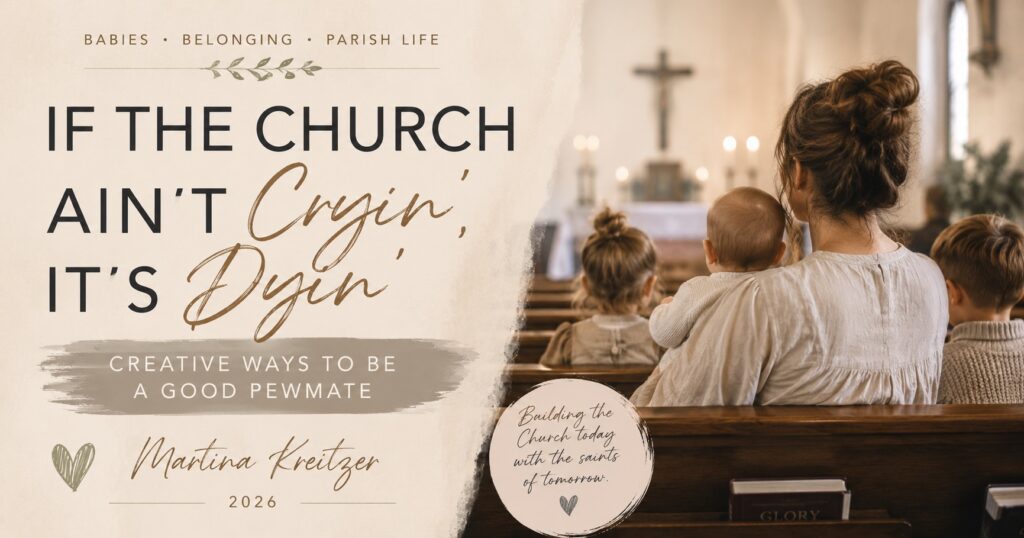

There was a season when we took up half a pew.
Not an exaggeration. Between the infant carrier, the diaper bag that doubled as a weekender, the toddler who needed the window seat so she could watch for Jesus to come out of the tabernacle, and the oldest who had graduated to holding her own missal but still needed reminding which page we were on – we were a production. A loud, beautiful, slightly chaotic production that arrived with enough time to issue apololgies ahead of the inevetible screams and toys being chucked about (once a toddler shoe came flying out of nowhere and hit a favorite pewmate of mine – MORTIFIED) and probably disrupted more than a few rosaries along the way.
I remember watching my husband dart onto the altar to retrieve an unruly two year old boy after Good Friday stations of the cross and Seven Last Words had begun. Deacon Richard didn’t even bat an eyelash. But you’d better believe I remember the looks…and the laughs by those who understood. Moreover, I remember the grace of the people who did not give us the looks – the older woman who smiled at us from across the aisle, the usher who held the door without a word, the priest who paused mid-homily, grinned at the shrieking baby in the front row, and said “that one agrees with me” before continuing without missing a beat.
Now my circus has shrunk. My kids file in, find their place, and kneel without being asked. Several of them have moved on to become altar servers, so we have even fewer children in the pews these days. Consequently, I find myself watching the young mom three rows up – the one with the diaper bag the size of carry-on luggage, the toddler who just launched something in the direction of the usher, the baby who has chosen the Liturgy of the Word as her moment. I know that mom. I was that mom. And honestly, I am not sure the parish has gotten much better at receiving her since I was white-knuckling it through the Gloria.
So this post is for all of us – the young mother in survival mode, the veteran pewmate who has forgotten what it cost her to get here, and the priests who set the culture for everyone else. Because a Church without crying babies is a Church without a future. Hence the title.
The Theology in Thirty Seconds
Jesus did not say “let the children come to me quietly and in an orderly fashion.” He said let them come. Full stop. The noise, the rustling, the dropped missalette, the Cheerio that rolled three pews forward – none of that is a disruption to worship. In many ways, it is worship. It is the sound of the future showing up. It is the domestic Church doing the hardest and holiest thing it does – dragging itself to Mass anyway, on no sleep, with crackers in its pockets, because it knows something irreplaceable happens here.
Furthermore, the faith gets into children before they can articulate it. The incense, the bells, the rhythm of the liturgy – all of it forms them long before they understand a word of the homily. Consequently, bringing them early and bringing them often is not an act of optimism. It is an act of faith.
“A Church without crying babies is a Church without a future.”
For the Young Mother in the Trenches
First of all – you are not ruining anyone’s Mass. You are building the Church. Hold that truth like a life preserver on the Sundays when it does not feel that way.
Here is what actually helps.
Sit up front
This one is counterintuitive, and yet it works. Up front, they can see what is happening – the altar, the candles, the movement of the liturgy – and all of it holds their attention in a way that the back of someone’s head simply does not. Moreover, Father can see them. And a good priest, which most of them are, will smile at your toddler from the altar in a way that makes both of you feel like you belong there. Because you do.
Pack the tote bag
Not the iPad. The tote bag – soft quiet books, a children’s board book version of the Mass, a holy card they can hold, a small saint figure they can turn over in their hands. The goal is quiet engagement, not distraction. Our own CS contributor put together the definitive Mass bag guide and it is worth bookmarking before next Sunday.
Additionally, a few of our favorite Catholic small shops have exactly what you need. Be a Heart Design makes beautiful soft Jesus, Mary, and Joseph dolls and wooden puzzles perfectly sized for little hands in the pew. Gather and Pray carries Montessori-style wooden Catholic toys and the most beautiful wooden rosary boards you have ever seen. Little Rose Shop has soft quiet books and stuffed saint dolls that double as comfort objects on hard Mass days. For books, Tan Books carries Fr. Ben Gets Ready for Mass and the St. Joseph picture books that have been a staple in Catholic tote bags for decades. And yes – snacks are not cheating. They are survival. God made Cheerios too.
Bring them often
Do not wait until they are ready. They will never be ready – so bring them anyway. The Mass gets into children before they understand it, and one day, without your even noticing, they will find their own place in the missal and kneel without being asked. Therefore, every Sunday you show up is an investment, even the ones that feel like a complete disaster. Especially those.
About the cry room
The cry room is a gift, not a sentence. When a child needs to be soothed, take them – step out, calm the storm, and then come back. The goal is return, not exile. A good cry room has a speaker so you can still hear the Mass, a window so you can still see the altar, and enough space that you do not feel like the parish has sent you to the vestibule as a punishment. Furthermore, your presence at Mass matters even from the cry room. Even when it feels like you caught approximately none of it, you showed up. So did they. That matters more than you know.
One more thing, said with love: the cry room is not a lounge. If you are not wrangling a child who needs soothing, you do not belong in there during Mass. It may seem harmless to slip in for a quieter experience or a better view – but consequently, when that space fills up with adults who are not managing anyone, it sends a quiet but real message to the mother standing at the door with a screaming infant and nowhere to go. She will turn around and go back to the pew and white-knuckle it. She may leave early and she may not come back. Therefore, if you find yourself cry-room-curious but child-free on a given Sunday, slide to the middle of a pew instead and leave that escape hatch for the people who actually need it.
For the Veteran Pewmate
You made it. Your pew is calm. Your missal is already open to the right page and your coffee is in the car and you arrived with three minutes to spare. Congratulations – genuinely.
Now slide to the middle.
Leave the aisle seat
Aisle seats serve two groups of people at Mass: the elderly who need quick access for mobility and assistance, and parents of small children who need an escape hatch. If you do not fall into either of those categories on a given Sunday, slide in and make room. The aisle seat is the difference between a graceful exit to the cry room and a full pew interruption involving four people, a diaper bag, and an infant who has now escalated. It costs you nothing. It means everything to the mother who needs it.
About the stink eye
You know the one. The slow turn. The pointed look in the direction of the noise. The sigh that is just barely audible. Most of us have done it – or been sorely tempted. And listen, the struggle is real. You came to pray, not to listen to someone else’s toddler narrate the homily at full volume. However, here is the thing: that mother already knows. She is more aware of every sound her child is making than you will ever be, and she does not need your assessment. What she needs is the grace you have spent years accumulating at this very altar.
So instead of the look, try a smile. A small one. The kind that says “I remember.” Because you do.
What to offer instead
A smile is free. So is holding the door. So is the quiet “you’re doing great” on the way out that costs you ten seconds and might be the thing that brings her back next Sunday. Consider the older woman I mentioned – the one who smiled at us from across the aisle during our loudest years. Her name I never learned. We never spoke. Nevertheless, I remember her every time I sit in a quiet pew and watch a young mother negotiate the Consecration with a squirming two-year-old. She showed me what it looked like to receive a chaotic family with grace. Be her.
For the Priests Who Get It Right
Most of them do. That deserves to be said plainly and said first.
The priest who smiles from the altar when the baby starts up during his homily preaches something in that moment that no words can match. The priest who waves the family back in from the vestibule instead of waiting for silence tells everyone in the pew exactly what kind of parish this is. Furthermore, the priest who works a warm joke about the noise into his homily does more for parish culture in thirty seconds than a hundred bulletin announcements ever could. Pastors set the culture – and when Father receives the chaos with grace and even a little humor, the pew follows. Give them a good example to follow.
Additionally, the cry room is a pastoral decision, not an architectural afterthought. A good cry room has a speaker connected to the Mass, a window with a clear view of the altar, and enough space to communicate welcome rather than exile. When a young family walks in and finds a converted storage closet with a fuzzy speaker and a broken blind on the window, they receive a message. Conversely, when they find a space clearly designed with them in mind, they receive an entirely different one. The infrastructure of welcome matters – and consequently, it starts at the altar and works its way out to every corner of the building.
Closing
The Church is supposed to be loud with new life.
The crying, the rustling, the dropped missalettes, the Cheerio that made it all the way to the front pew – that is the sound of the future showing up. Our job, every one of us, is to make sure it feels welcome enough to come back next Sunday. And the Sunday after that. And every Sunday after that, through the toddler years and the squirmy elementary years and the eye-rolling middle school years, until one day they are the ones sliding to the middle of the pew to make room for someone else’s circus.
That is how it works. Furthermore, that is how it has always worked. And that is why the Church is still here.
So slide over. Smile at the baby. Leave the escape hatch open.
Oh, and that unruly two year old? He’s graduating from high school and concluding his nine years of being an altar boy. Believe it or not, I still rib him about that stint all those years ago. He still tells me he’ll try to behave during Mass. He’s enlisted in the Marines – hang in there, Momma. There is hope. 😉
The Church is counting on all of us to get this right.
From the Vault
Related reading from the Catholic Sistas archives:
- 16 Things You Need in Your Kids’ Mass Bag
- Confessions from the Pew
- A Letter to My Daughter on Her First Holy Communion
- 20 Habits You Can Cultivate NOW to Help Your Children Stay Catholic
- How to Bind Your Family to Heaven Without Using Duct Tape
- Approaching Communion with the Faith of a Child
Reflection Questions
Young Mother:
- Are you sitting where your children can see the Mass – or hiding in the back hoping no one notices?
- Do you have a tote bag ready, or are you improvising every Sunday? What would actually help you prepare?
- Do you know where the cry room is at your parish – and do you feel welcome returning to the pew after using it?
Veteran Pewmate:
- When did you last smile at a struggling young mother at Mass instead of looking away?
- Are you sitting on the aisle when you do not need to be? Could you slide over?
- Who made you feel welcome during your hardest Mass years – and are you being that person for someone else?
Priests:
- Does your cry room communicate welcome or exile?
- When a child makes noise during your homily, what does your face do?
- What is one thing you could do this Sunday to signal to young families that they belong here?