

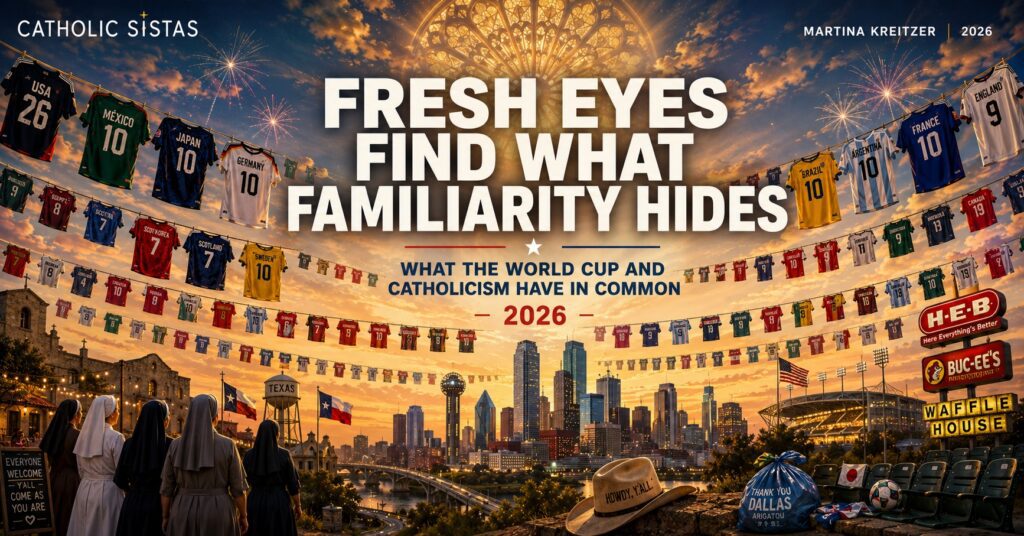
Fresh eyes find what familiarity hides.
What do the World Cup and Catholicism share? More than you might think. Something is happening across America right now that started as a soccer tournament and turned into something else entirely — a lesson in seeing what familiarity teaches us to overlook.
The soccer is real. Forty-eight nations descended on eleven American cities this summer — Atlanta, Boston, Dallas, Houston, Kansas City, Los Angeles, Miami, Philadelphia, Seattle, San Francisco, and New York — for the biggest FIFA World Cup in history. But nobody fully anticipated the other thing. The thing happening in the aisles of HEB at 10 a.m. on a Tuesday. The thing showing up in millions of social media posts from visitors who came to watch soccer and ended up falling in love with everything else.
They came as strangers. Something happened to them that they were not expecting.
What the World Cup Showed Us About America
A German fan named Freddy drove through the American South on a six-week road trip and started posting about it online. His first Waffle House visit: a 10 out of 10. His first Buc-ee’s: “DUDE LMAO THIS IS A GAS STATION.” Taco Bell he described simply as “the holy land.” A Leeds fan in Chicago stumbled into a five-story Starbucks and could not get over it. Elsa Thora, a Swedish fan traveling through Indiana, tried ranch dressing for the first time and went fully viral.
And then there is HEB.
If you are a Texan, you already know. HEB is not a grocery store. It is a civic institution, a love language, a point of pride so specific it practically has its own flag. Visitors from Scotland, Brazil, and Japan have been walking through those automatic doors and stopping cold — the prepared foods, the local products, the sheer Texas-ness of the place — posting their reactions to the delight of approximately every Texan alive. HEB leaned in fully, releasing World Cup merchandise that sold fast, because of course they did. A Texas grocery store with a FIFA jersey is not a contradiction. It is a thesis statement about what Texas actually is: generous, proud, a little extra, and completely serious about hospitality.
This is the detail the media never gets right about Texas or America. The same tired narratives run on a loop, and some visitors arrived carrying those narratives like luggage. They had pictures in their heads assembled from news segments and social media algorithms. Those pictures looked nothing like what they found when they actually showed up, walked around, talked to people, and ate the food.
Warmth is what they found instead. Generosity. Wide open spaces and a diversity of landscape and culture that no chyron can communicate. The actual, everyday, holding-the-door-open, asking-how-your-trip-is-going American people turned out to be nothing like what anyone had told them.
The Japan Moment
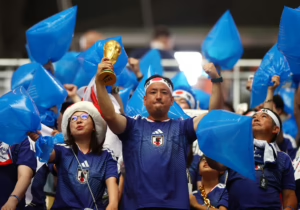
After the Netherlands-Japan match in Dallas on June 14th, the final whistle blew and most fans headed for the exits. The Japanese supporters reached for something else entirely — blue plastic trash bags. Hundreds of them worked methodically through the stands, picking up every cup, every wrapper, every discarded flag from another nation left on the ground. They cleaned what was not theirs to clean. The Japanese men’s team did the same in their locker room, leaving it spotless for the next occupants. This is not a new story. Japan has kept this tradition at every World Cup since 1998. It comes from a philosophy so simple it lands like a small correction to how the rest of us move through the world: a bird leaves nothing behind.
The Japanese fans in Dallas were not performing. They were just being Japanese. Americans who had never thought twice about leaving a popcorn bucket on the stadium floor watched those videos and felt something shift. A small, quiet recalibration.
What makes it richer is that Japan has loved Texas for decades, long before this tournament. In the Meguro neighborhood of Tokyo, there is a basement bar called Little Texas. A man named Takeshi Yoshino opened it in 2005 after spending twenty years making pilgrimages to the Lone Star State — collecting license plates, neon signs, pickup truck parts, and cowboy boots, all for the dream of building a honky-tonk in Tokyo. The walls are imported Texas wood. Chicken-fried steak and Texas-shaped waffles are on the menu. Live country music plays three sets a night. Yoshino’s devotion to a place he did not grow up in was so genuine and so extravagant that the Governor of Texas eventually named him an Honorary Texan.
He loved Texas more fiercely — and more specifically — than many Texans love Texas.
The city-country pairings of this World Cup have a way of revealing something true. Scottish fans serenading a Boston neighborhood with bagpipes at dusk feels almost eerie in how right it is — Boston has been Irish-and-Scottish since before it was American. Mexican fans who made Houston their base camp need no translation, because Houston has always been both — and they have been showing up at the FIFA Fan Festival in East Downtown every single day, loud and joyful and completely at home. Mexican and Korean fans sharing stadiums in Guadalajara and Monterrey — drawn together by the World Cup bracket into the same Group A — have been flooding the streets of Mexico together, two nations with wildly different cuisines and cultures finding common ground over the beautiful game.
Korean fans discovering birria tacos and Mexican fans discovering Korean BBQ, both of them recognizing something in the other: the long smoke, the patience, the pride that rhymes across every culture that takes its food seriously. And if the late-night street videos are any indication, neither side has been in any hurry to call it a night. This is what it looks like when joy has nowhere to be in the morning. These pairings do not feel random. They feel chosen.
And it turns out the Church noticed. Pope Leo XIV — the American pope, the first from the United States – dedicated his June prayer intention to exactly this moment. He prayed that sport would always be a school of fraternity and a space of encounter rather than division. An American pope praying over an American World Cup, asking God to let the game do what games do at their best: turn strangers into neighbors. That prayer is being answered in real time on the streets of Boston and Dallas and Houston, in the stands of every stadium, in every HEB aisle where someone from another country stops dead and thinks — oh. This place is wonderful.
Honestly? We should do this every summer. Not the World Cup specifically, but this — opening the doors wide, watching people from Edinburgh and Tokyo and Mexico City fall in love with brisket and bagpipes and HEB, seeing our country through eyes that have not gone tired of it yet. We as Americans should be so lucky to call these people our guests regularly. They are, as it turns out, exactly the cousins we did not know we had.
None of this got filtered through a newsroom. The everyday person had the megaphone. People pulled out their phones, posted what they were actually seeing, and millions watched. The narrative got written from the ground up. This is America’s 250th year. The whole world showed up to celebrate with us — and the story they told about us was better than anything we could have scripted for ourselves.
You do not need permission to love your country. The ordinary American is extraordinary. Some visitors from Scotland and Germany and Japan just reminded us.
“People are kind of amused seeing me experience America and thinking so big of little things for them, because if you live here, you might just be used to it. But for someone like me — it’s really cool.” — Elsa Thora, Swedish World Cup visitor
What Exactly Do Catholicism and the World Cup Have in Common?
Someone who arrived in Dallas this summer already knew what the Japanese fans would do. She had read about it after Qatar 2022, found it quietly moving, and filed it away in the part of her mind that collects evidence of human dignity. She is a convert to Catholicism — came in three years ago after a decade of circling. And she has been watching these World Cup moments with a particular kind of recognition.
She knows what it is to walk into something you had been told was one thing and find it entirely another.
She arrived carrying what the media, her upbringing, and a few old wounds had assembled about the Catholic Church — that Catholics worship Mary, that we check our brains at the door, that it is all rules and guilt and scandal with no room for questions. Cautious is the word for how she walked in. Then something happened.
In a quiet chapel, sitting before the Blessed Sacrament during Eucharistic adoration, she felt something she had no category for. Confession came next, and she walked out lighter than she had felt in years — the mercy of God handed to her personally, spoken aloud, finished. The saints arrived after that: this wild and enormous communion of people who have gone before us. For the first time, she realized she had been alone in a way she had not known she was alone. Then came Augustine, then Aquinas, then John Paul II’s Theology of the Body — and the Church she had been warned about turned out to be the most intellectually serious institution she had ever encountered.
She texted you: Why did nobody tell me about this?
You, cradle Catholic, looked up from the pew where you had been sitting on autopilot for twenty years and thought: oh. Right. This is extraordinary. I just forgot.
The convert does not take for granted what the cradle Catholic has stopped seeing. That is not a rebuke. It is an invitation to look again.
We Have a Freddy Problem
Those of us born into the faith have this in common with people who grew up taking Waffle House for granted: we stopped noticing what we were given. The FIFA World Cup gathers 48 nations for 39 days and the whole world loses its mind with joy.
The Catholic Church has been gathering every nation on earth at the same table, under the same Blood, for two thousand years – and we call it a Tuesday. The Eucharist – the actual Body and Blood of Jesus Christ, present on the altar at every Mass in every parish in every city in the world – is the only World Cup that never ends and never turns anyone away. The liturgical year carries us from Advent through Christmas through Lent through Easter through Pentecost. It is the most elegant structure of meaning ever arranged around a human life — can start to feel like a calendar.
Confession, which is nothing short of a miracle, can start to feel like an appointment.
We have been living inside Buc-ee’s and calling it a gas station.
Saint Paul did not grow up in the faith. The road to Damascus tackled him — knocked flat, blinded, renamed, redirected. Recovery never came, and he never sought it. Letters poured out of him from prison. Shipwrecked, beaten, still going. That is convert energy in a single person. That is what it looks like when someone meets the living God without years of familiarity softening the impact.
We need the Pauls and we need the Freddys. We need the people who walk in without our assumptions, see what we have stopped seeing, and lose their minds about it in the best possible way.
Gratitude: What the World Cup and Catholicism Both Teach Us
What the World Cup visitors and the converts share is this: they are grateful. Loudly, specifically, almost embarrassingly grateful. In the way you can only be when something exceeds your expectations so completely that you cannot keep it to yourself.
Gratitude is contagious.
Consider what happened when Freddy posted his Waffle House video. Americans who had eaten there a hundred times watched it and felt something they had not expected — a small re-enchantment, a flicker of oh yes, this is ours and it is wonderful. In the same way, when photos of Japanese fans cleaning Dallas Stadium went viral, people who had never once thought about what they leave behind felt something quietly shift inside them. And then there is your convert friend. When she described her first Easter Vigil, something happened in you too — even if you have been to twenty. Suddenly you saw it through her eyes, and just like that, you remembered: this is the night. This is the night that changes everything.
We are 250 years into this American experiment and the whole world showed up to our birthday party. We are two thousand years into the Catholic faith and people are still walking through the doors for the first time. And they are being completely undone by what they find inside. Both of those things are worth stopping to receive.
You do not need the media to tell you how to feel about your country. You do not need a permission slip to love your faith. The World Cup and Catholicism are teaching the same lesson right now, from Dallas stadiums to Easter Vigil chapels. The ordinary, everyday, quietly magnificent reality of both is right in front of you.
Fresh eyes find what familiarity hides.
Open yours.


